Inquiry
Form loading...
Choosing a China Best Large Spectacle Case Manufacturer involves more than comparing unit prices. A roomy case must protect oversized frames without becoming awkward to carry. Consider the hinge, lining, closure, and shell strength. A frame should sit inside without its lenses pressing against the fabric. Small details matter.
Industry reports offer useful context, but their limits matter too. Grand View Research’s Eyewear Market Size, Share & Trends Analysis Report examines the broader eyewear market, not large spectacle cases as a separate category. That distinction is important. It means buyers should not mistake eyewear-market growth figures for verified case-market demand. For sourcing decisions, request measurable evidence: material specifications, sample evaluations, production capacity, and documented quality checks. A polished catalog is not proof.
Design gives another practical lens. Industrial designer Dieter Rams said, “Good design is as little design as possible.” Applied here, that means a case should protect frames and remain easy to open, rather than collect decorative features. Think of a pair of wide acetate glasses sliding into a soft-lined shell, with enough clearance around the hinges. Simple. Useful. Still, this principle cannot replace factory inspection or buyer testing. I would want to see how the lining wears after repeated use, not just how it looks on day one. A reliable manufacturer should welcome those questions, explain its limits, and support claims with samples and records.
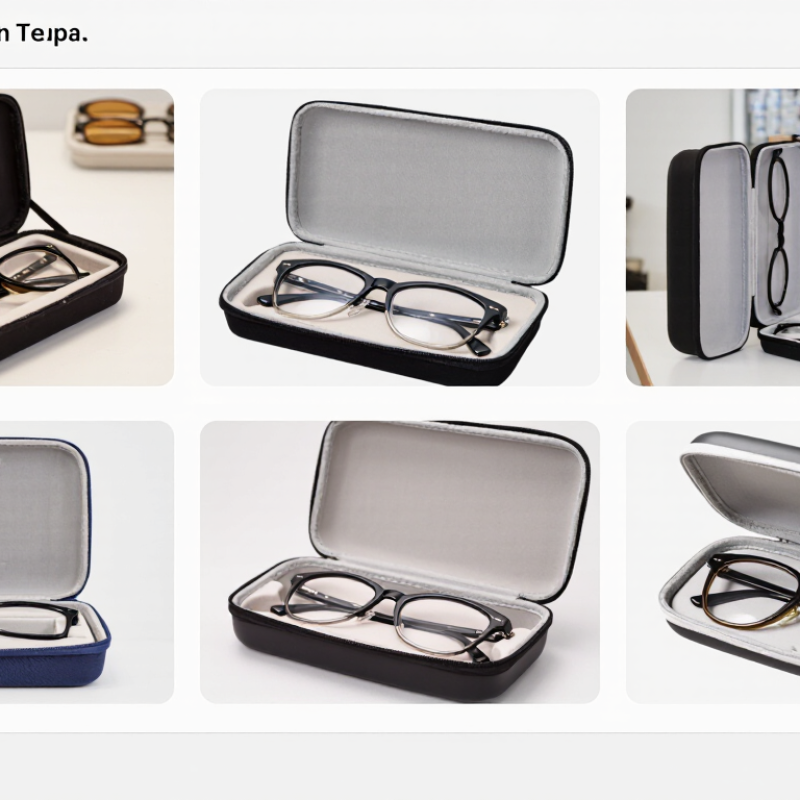
China’s large spectacle case manufacturing combines tooling, injection molding, metal fittings, lining, and surface finishing. Suppliers can produce rigid shells for protection or soft cases for lighter, compact storage. The production chain is practical, but quality still varies between factories.
Grand View Research’s 2023 eyewear market report estimated the global market at USD 169.4 billion in 2022, with an 8.3% projected compound annual growth rate from 2023 to 2030. This measures eyewear, not spectacle cases, so it signals demand context rather than case sales. For buyers, useful checks include hinge alignment, shell thickness, seam strength, and whether the lining sheds fibers. Small details matter. A sample may look polished, yet repeated opening can expose a weak hinge or loose stitching.
Tips: Request a pre-production sample and test it with the intended frame size. Check the case after repeated opening and closing, not just on arrival. Confirm material specifications in writing, and ask how color or logo placement is inspected. A slightly uneven finish can happen; consistent defects deserve a closer review.
| Manufacturing Dimension | Overview | Practical Details |
|---|---|---|
| Product Design | Large spectacle cases are designed to accommodate oversized frames, including styles with wide fronts, deep lenses, or extended temples. | Case dimensions should be set around the intended frame, with room for insertion and removal without forcing or bending the frame. |
| Size Specification | There is no single universal size for a large spectacle case. Dimensions vary with the frame shape, protective structure, and closure design. | Measure the frame’s maximum width, height, and depth. Add suitable internal clearance, then verify the fit with a physical sample. |
| Common Shell Materials | Rigid cases may use formed metal, molded plastics, or composite constructions. Soft cases commonly use textile or synthetic-leather outer materials. | Material selection affects weight, shape retention, surface finish, cost, and the level of impact protection provided by the case. |
| Interior Lining | Soft linings, such as brushed textiles or microfiber, help reduce direct contact between the frame and the case interior. | The lining should be securely attached and free of loose fibers, rough seams, or exposed edges that could scratch or catch on the frame. |
| Forming and Assembly | Manufacturing steps depend on the design and materials. They may include cutting, forming or molding, edge finishing, lining, and assembly. | For a rigid case, shell halves and closure components are assembled and checked for alignment. Soft cases are generally cut, stitched, and finished. |
| Closure Options | Common closure types include hinged metal frames, snap closures, zippers, and magnetic closures. | The closure should open and close consistently while keeping the case secure during ordinary handling. Compatibility depends on the case construction. |
| Surface Finishing | Exterior finishes can include coated, laminated, printed, textured, or fabric-covered surfaces. | Check that the finish is even and that seams, corners, and edges are clean. Coatings and adhesives should be selected for the intended material combination. |
| Quality Checks | Typical checks include visual inspection, dimension verification, closure operation, lining attachment, and fit testing with the intended frame. | Inspection criteria should be defined before production. Sample checks can identify issues such as uneven seams, poor alignment, or insufficient internal clearance. |
| Packaging and Handling | Cases may be packed individually or grouped for shipment, depending on the product and order requirements. | Packaging should help prevent crushing, surface abrasion, and moisture exposure during storage and transport. |
| Customization | Custom options may include case dimensions, material, lining, color, surface finish, and closure style. | Provide a frame sample or detailed measurements when requesting a custom fit. Confirm material, construction, and approved sample specifications before production. |